
Blog
Blog No. 39 – December 7, 2025

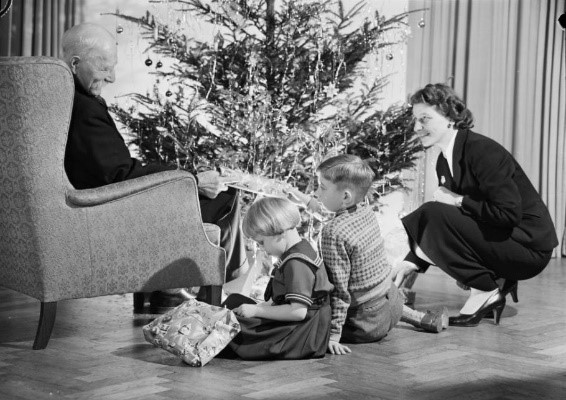
It was 1944 and Grandpa explains their daddy sends them xmas gifts from far away.
Child Boy: Just like Santa?
Grandpa: Yes, just like Santa.
Child Girl: Does he have a sled like Santa?
Grandpa: Well, it has wheels with rubber rotating them.
Child Girl: Is it snowing there?
Grandpa: Yes, and it’s a forest.
Child Girl: What is the name of the forest, Grandpa?
Grandpa: It is called Hüertgen Forest.
Child Boy: Is it cold?
Grandpa: Yes, it is very cold.
Child Girl: It’s Christmas. Does he have a Christmas meal?
Grandpa: Yes, he does. They are bringing special meals to all the men there today.
Child Boy: Then will he be able to come home?
Mother: Pray, my children. Pray daddy comes home. Pray for peace.
Christmas Eve 1944: a brief moment of peace on the battlefield
While the “Christmas Truce” of 1914 has achieved legendary status in the history of World War I, there has been little coverage of similar events involving American troops. When America entered World War I, years of massive casualties discouraged any brotherly feeling between the opposing armies, and senior officers actively discouraged any repeat of the events of 1914. In World War II, there were few chances for such events, as American troops were in close contact with German forces only in relatively small numbers in North Africa and Italy prior to the 1944 D-Day landings. Any large scale truce for Christmas 1944 was impossible as just nine days prior to Christmas, the Germans launched their largest counteroffensive of the war in the west, resulting in the Battle of the Bulge and heavy fighting throughout the holiday.
Yet while there is no mention of any “Christmas truce” in the official records, we do have a personal account of a much smaller truce during the height of the fighting in the Battle of the Bulge. This is the story of Fritz Vincken, a young German boy at the time of the battle. Fritz, then 12-years-old, had moved with his mother to a small cottage in the Huertgen forest after their hometown of Aachen was partially destroyed in an earlier American offensive. The area had stayed quiet until nine days before Christmas, when the German Ardennes Offensive had crashed through the area. According to Fritz, “we heard the incessant booming of field guns; planes soared continuously overhead; at night searchlights stabbed through the darkness.”
On Christmas Eve, 1944, Fritz and his mother answered a knock at the door — three American soldiers, one badly wounded, were standing there. While the Vinckens did not speak English nor the Americans German, they were able to communicate to a limited extent in French. Fritz’s mother invited the Americans inside and attempted to make them comfortable. Fritz remembered:
“We learned that the stocky, dark-haired fellow was Jim; his friend, tall and slender, was Robin. Harry, the wounded one, was now sleeping on my bed, his face as white as the snow outside. They’d lost their battalion and had wandered in the forest for three days, looking for the Americans, and hiding from the Germans. They hadn’t shaved, but still, without their heavy coats, they looked merely like big boys. And that was the way Mother began to treat them.”
Fritz’s mother made a meal of potatoes and a rooster, previously being saved for a reunion with Fritz’s father. As they cooked, there was a second knock on the door:
“Expecting to find more lost Americans, I opened the door without hesitation. There stood four soldiers, wearing uniforms quite familiar to me after five years of war. They were Wehrmacht – Germans! I was paralyzed with fear. Although still a child, I knew the harsh law: sheltering enemy soldiers constituted high treason. We could all be shot!”
The corporal leading the German patrol told Fritz’s mother, “we have lost our regiment and would like to wait for daylight…can we rest here?”
“Of course,” she replied, “you can also have a fine, warm meal and eat ‘til the pot is empty. But we have three other guests, whom you may not consider friends. This is Christmas Eve, and there will be no shooting here.”
The corporal demanded, “Who is inside? Amerikaner?”
Fritz’s mother replied, “Listen. You could be my sons, and so could they in there. A boy with a gunshot wound, fighting for his life, and his two friends, lost like you and just as hungry and exhausted as you are. This one night, this Christmas night, let us forget about killing.”
The Germans stacked their arms by the door, and after a quick conversation in French the startled Americans also turned over their weapons to Fritz’s mother. The entire mixed group, somewhat tensely, sat down and shared dinner. According to Fritz:
“Relaxation was now beginning to replace suspicion. Even to me, all the soldiers looked very young as we sat there together. Heinz and Willi, both from Cologne, were 16. There German corporal, at 23, was the oldest of them all. From his food bag he drew out a bottle of red wine, and Heinz managed to find a loaf of rye bread. Mother cut that in small pieces to be served with the dinner; half the wine, however, she put away, ‘for the wounded boy.’ Then Mother said grace. I noticed that there were tears in her eyes as she said the old, familiar words, ‘Komm, Herr Jesus. Be our guest.’ And as I looked around the table, I saw tears, too, in the eyes of the battle-weary soldiers, boys again, some from America, some from Germany, all far from home. Just before midnight, Mother went to the doorstep and asked us to join her to look up at the Star of Bethlehem. We all stood beside her except Harry, who was sleeping. For all of us during the moment of silence, looking at the brightest star in the heavens, the war was a distant, almost-forgotten thing.”
The truce held through the morning, Christmas Day, when the two sets of soldiers shook hands and departed, each headed back to their own army.
- It is likely that there were other such small scale truces, or at least tacit agreements between local American and German units to refrain from attacks and firing on Christmas Eve and Christmas Day, perhaps in Italy in 1943 or in quieter parts of the line in 1944, but this is the only documented case currently known.
- This is a condensed version of a story first related in Vincken, Fritz, “Truce in the Forest,” Readers Digest, January 1973, pp 111-114.
- From: Christmas Eve 1944: a brief moment of peace on the battlefield
- Published December 23, 2020
ABMC is a proud partner of
The American Battle Monuments Foundation
Other Christmas Eve stories (the first is a repeat of the above, longer version):
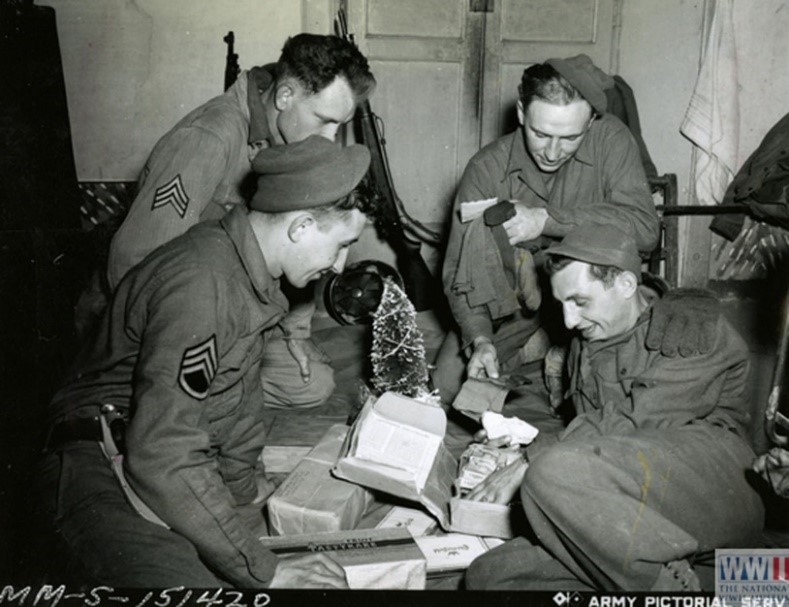
Xmas in Italy. Huddled around miniature Xmas tree opening packages from home are, in front row, L to R: S/Sgt John F. Suchanek of NYC, and PFC Joseph G. Pierro of Jersey City, N.J.; Back row, L to R: Sgt. Charles M. Myrich of Centerville, Cal., and Sgt. Leon L. Oben of Bemidyt, Minn. Confidential Sig (Signal) Corps Photo 12-19-43.
(NOLA Public Domain)
They shared. That’s what they did. There was great camaraderie. They were all in the same boat, as it were. It didn’t matter whether they enlisted, whether they were drafted, just how they ended up where they were. When they faced each other, when they looked into each other’s eyes, that exchange of glances told their buddy that they knew, that they understood the pain of not being back home with a friend or a loved one on this holiday – or, if they didn’t celebrate this particular day, they understood what it meant just not being home. Not necessarily home with friends or family, but home meaning NOT WHERE THEY WERE with enemy forces holding munitions pointed at and firing directly at them. But why? What did they do to cause that? They meant no harm to their physical being. That was, perhaps, their thought. Most were good people. Bullets and other deadly ammo were laying them straight – out of commission, down in pain, or only plain dead. So, what did they do? They shared. For many of these servicemen, they were gifted Christmas dinners by their family.
Fortunately, family holiday means were received by the servicemen, but it was scarce amongst many. However, the Red Cross and United Service Organizations (USO), thanks to our government, organized special holiday meals. These were complete with roast turkey, mashed potatoes with gravy, and pie. Not only were they received on the battlefront, but the service men and women received them on the homefront also. In some cases where permitted and situated, field kitchens were already in situ or specially set up and hot meals were prepared for the soldiers in combat zones. However, according to the local conditions, certain staples were not present as normally expected. You can bet, though, it was the ability to not only receive this meal, but having one to share with your comrade rekindled the holiday spirit and perked up enough energy — mental and physical in many cases, to continue to. They wanted the real thing. They wanted to relive this holiday spirit back home. Those service people who were stuck with canned rations, with the Turkey Lod, having no choice, would make the best of it, they would receive their meals from home, when available, they shared.