
Blog
Blog No. 40 – December 31, 2025

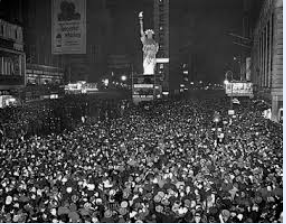
The 1944-1945 Celebration was the 41st New Year’s Eve celebration in Times Square, New York and took place on Sunday, December 31st, 1944. (Public Domain)
The Times Square Ball in 1944 wasn’t dropped because of wartime dim-out orders, but the version in use before that suspension (from 1920) was a 400-pound sphere made entirely of wrought iron, featuring incandescent bulbs for lighting. It replaced the first iron and wood ball from 1907, reflecting technological changes with a simpler, metal-only design.
The time was 1944 almost 1945. The scene was New York City Times Square. The ball would not be dropped that year from a flagpole atop the One Times Square building. The scene was the Ardennes forest region primarily in Belgium and Luxembourg, extending into Germany and France of Europe. The bombs were being dropped on our troops at the Battle of the Bulge. One ball would have been dropped in Times Square. Many were being dropped in the Ardennes forests. Specifically, Operation Bodenplatte (Baseplate) was launched by the German Luftwaffe on January 1, 1945. It was a last-ditch attack hoping to achieve air superiority. This low-level mass air bombardment hit 17 Allied airfields in Belgium, the Netherlands, and in France.
As a result, this year in Times Square the mood of the people changed and so followed the celebration. No longer was there the grand spectacle that was expected by the growing crowds. The energy restrictions of the war effort were supported. Now heads were hung low. People observed a minute of silence. No one had to guess whatfor. Thereafter, everyone could hear the ringing of chimes from trucks who gathered for the unforgettable somber occasion. The tradition was severely broken.
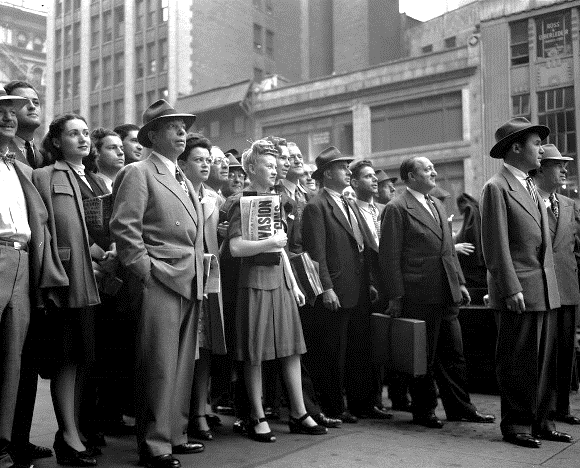
People gathered in Times Square to watch the news ticker on the New York Times building. See: When New Yorkers Heard About the D-Day Invasion: Photos From 1944 – Rare Historical Photos
Still, the celebrants gathered at the end of 1944, but this year the crowd below the dropping of this year’s New Year’s ball were also anxiously looking up at what was called the “zipper,” that electronic news ticker on the Times Tower. They were nervously reading the updates on those bombs that were dropping on the freezing troops at the Battle of the Bulge and on the icy forests of
the Ardennes. Those fortunate to be seated in the victory-type seats, instead of raising their arms in succession creating the ripple effect called the Wave, they were now seen shaking their heads together in slow motion, like those clowns at circuses where they are connected by one stick behind their backs. Only this time it wasn’t funny at all.
So, by the countdown from 10 to 1, to New Year’s Day of 1945, between the falling ball and the ticker tapes, these falling bombs, and the result thereof, many families across our country and elsewhere received those dreaded telegrams telling of the nearly thousands of war casualties suffered during these battles. Yes, this was an altogether different atmosphere for a turnover new year celebration – those who sang and danced once out of pure joy now with their heads touching their chests sobbed their hearts out from a conflict that never should have been.
Looking around the world, you would find that atmosphere was the same. Many towns saw not fireworks but artillery shooting off into the sky. Even in liberated Paris, while gunfire was said to be heard echoing throughout the same freezing Ardennes forests, people were popping champagne corks just as many gathered back in NYC in Times Square. Dancing was subdued. Laughter was intermixed with crying. But here’s the real thing. There was something that was a universal feeling. People of the world were now demanding justice — they wanted accountability, they wanted past wrongs made right, they expected a confrontation where there was punishment for actions or even failures of action. The world seemed to be looking for a “day of reckoning.” To this very day, there are trials ongoing seeking those responsible.
U.S. POWs on 22 December 1944
(Public Domain)
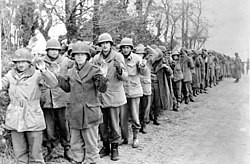
One must always remember by looking into those foxholes and at the POWs. Those freezing soldiers, those cold and starving prisoners were holding on to dear life; they were looking to be freed through the barbed wire fences that blocked them from celebrating on New Year’s Day. The Battle of the Bulge that was covered with snow now was soaked with blood; and the gates at Auschwitz that were swung wide open revealed what some still cannot speak of today. It was truly, if you think about it, a “new year” that humanity everywhere was standing on an edge of some sort of liberation. Father Time, viewing the turnover from 1944 to 1945, might see a switch over, perhaps, of horror to victory to freedom. Some would say, Well, that’s one way to look at it. Others might say that Father Time’s New Year embodied both the passage and end of horrific things and the beginning of new, meaningful things, that it was a time for “a Day of Reckoning.”